Published:
While some alumni continue in the field, others are putting the skills they've acquired in the program to use in a variety of careers.
Gain understanding of the human experience around the globe with a career-focused program led by renowned faculty.
When you study anthropology, you will learn an interdisciplinary approach to problem-solving that connects human behavior to cultures, histories, economics and politics. With their deep understanding of human diversity and global cultures, anthropologists are in high demand in fields like education, law, library science, museum administration and curatorship, advertising and marketing, public and civil service, medicine, dentistry, pharmaceuticals, and public health.
Anthropologists are in high demand in fields like education, law, library science, museum administration and curatorship, advertising and marketing, public and civil service, medicine, dentistry, pharmaceuticals and public health.
While some alumni continue in the field, others are putting the skills they've acquired in the program to use in a variety of careers.
The Bachelor of Arts in Anthropology provides a comprehensive education that focuses on the principal methods used in anthropology today. You can pursue three of the major subfields at Adelphi—cultural anthropology, archaeology and physical/forensic anthropology—as well as take advantage of the abundant research opportunities and fieldwork under the direction of our renowned faculty.
The BA in Anthropology also offers a concentration in environmental anthropology that integrates anthropology with many of the key perspectives from environmental studies. These courses demonstrate the critical relationship that exists between human settlement patterns and their environmental setting. Applications are drawn from the prehistoric past up through the contemporary world.
With the Bachelor of Science in Anthropology program, you will build a strong foundation in anthropology—the study of past and present cultures, biology, and languages—by studying geology, environmental studies, biology, chemistry or mathematics. You’ll learn how to conduct research in both the Archaeology Laboratory and out in the field, gaining an understanding of scientific methods as well as quantitative and qualitative analysis.
When you graduate, you’ll be equipped with the skills to effectively apply science-based approaches to any professional challenge you encounter. You’ll have a comprehensive awareness of ancient and modern civilizations and cultures—qualities that will enhance your résumé in the global marketplace.
The field of anthropology is complementary to other areas of study at Adelphi, thus providing many opportunities for double majors. The BS degree is also designed to work well with a double major in science, accepting credits from biology, chemistry, environmental science and math and computer sciences courses. Students should contact the department to explore their interests in completing a double major.
An anthropology minor is an excellent option if you are strongly committed to another major but you want to include anthropology courses in your curriculum. Since anthropology can effectively complement many majors, contact our department for guidance in planning a successful minor in anthropology.
The forensic anthropology minor emphasizes forensic archaeological recovery and documentation, forensic osteology, and pathology—all taught within the context of the cross-cultural perspective of anthropology. The minor is a grouping of both basic and upper-division courses in forensic anthropology, providing a comprehensive undergraduate specialization in this area of study.
The interdisciplinary food studies minor provides the opportunity to investigate the cultural, biological, historical, political, environmental and economic contexts of food in the human experience. The food studies minor complements a variety of programs across the University and has applications in environmental studies, health and nutrition, exercise science, hospitality, business, public policy, food management, communications, and many other careers.
My anthropology education at Adelphi provided a solid foundation in critical thinking and thinking across disciplinary boundaries—skills that are necessary to work in any field and be a good global citizen. I take this foundation and the supportive community I found while studying in Adelphi’s anthropology department wherever I go.
Extend your education to far-flung destinations like Alaska and Mumbai through our faculty-led fieldwork projects, which provide practical experience in archaeology, bioarchaeology, scientific illustration or ethnography.
Many anthropology students also secure internships at leading organizations in the New York area such as:
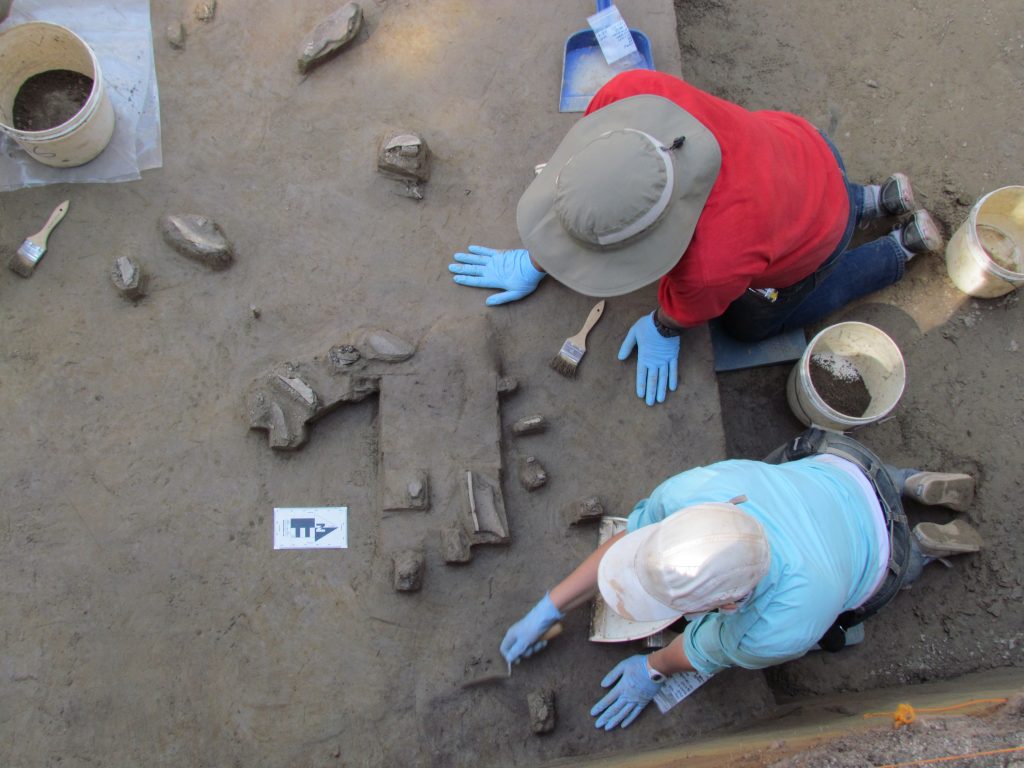
Adelphi anthropology students working in the field in Alaska.

When Alyssa Booth, now in her senior year, was trying to decide on a major, she wasn't sure which one was right for her. She wanted to choose a major that could take her across the globe, so she decided on anthropology. Little did she know that she "picked the perfect field" and would spend this past August in Japan learning more about an indigenous Japanese people, the Ainu.
To apply for this program, submit the appropriate application requirements:
All undergraduate students have the opportunity to apply for the following programs to expand their educational landscape: